Hot water recirculation pumps
Quick answer
Recirculation pumps make hot water available the moment you open a faucet. Families waste about 4,000 gallons a year waiting for hot water, so a pump pays for itself.
How a recirculation loop works
A storage water heater with a hot line to the farthest sink and a dedicated return pipe and pump back to the heater. Systems without a return pipe, and tankless units with built-in pumps, work differently. Pipe runs are shortened for clarity.
The system stays see-through with its parts labeled. Turn or zoom the system, then choose a part or a step. Use the arrow keys when the drawing is focused.
Still diagram and written explanation
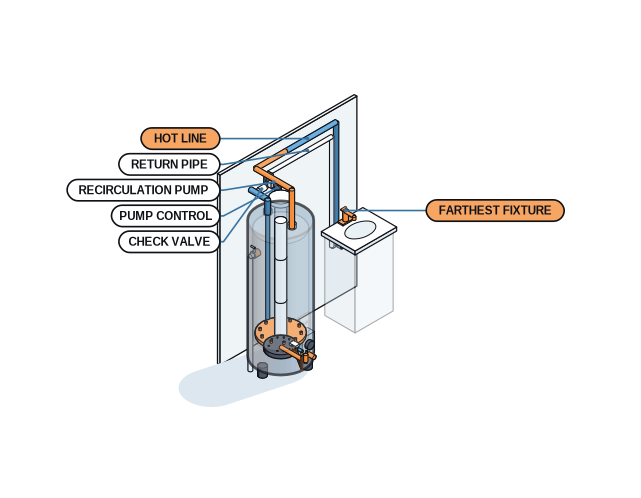
- Hot line
- Carries hot water from the heater to the fixtures. Water left sitting in it cools, which is the wait at the tap.
- Farthest fixture
- The tap farthest from the heater waits longest. The loop is laid out to reach it.
- Return pipe
- A dedicated pipe from the end of the hot line back to the heater, which makes the loop.
- Recirculation pump
- Moves cooled water from the hot line back to the heater through the return pipe, so hot water waits near the taps.
- Check valve
- Lets water move only one way around the loop.
- Pump control
- A timer, a thermostat, or a button or motion sensor decides when the pump runs. Running it only when needed saves energy.
- The wait at the tap. Water left in the hot line cools, so you run it off before hot water arrives.
- A loop back to the heater. A return pipe connects the far end of the hot line back to the heater, making a loop.
- The pump moves it. The pump sends the cooled water back to the heater, and hot water takes its place near the taps. The check valve keeps it moving one way.
- Control the run time. A timer, thermostat or on-demand button limits how long the pump runs. Hot water circulating all the time loses heat from the pipes.
- Other setups. Without a return pipe, some systems send cooled water back through the cold line using a valve under the far sink. Some tankless models have a pump built in. Which one fits depends on the heater and its manufacturer.
Before you touch the system. A pump or return pipe changes the plumbing and wiring. Have a qualified plumber choose and install a system that suits your heater; with a tankless, follow the manufacturer's requirements.
With a storage tank
A dedicated return pipe from the farthest fixture back to the heater works best, but adding one can cost $1,000 or more. Under sink pumps with a button or motion sensor work without one, but you have to remember to use them. Brandon's favorite is a thermovalve system on the heater that keeps the hot line hot with no extra pipe.
See a recirculation loop warm up
Brandon at Quick Water Heater · 1:05–3:10
Brandon uses a thermal camera to show a recirculation loop warming the pipes.
Watch on YouTubeWith a tankless
A tankless gives unlimited hot water, not instant hot water. Adding a separate pump forces the tankless to run constantly, which can cut its warranty or void it, and shortens its life. Choose a unit with recirculation built in.
Rather we did it?
Accessories we install