What is a pressure regulator?
Quick answer
A pressure regulator sits between the city water and your home and limits the pressure coming in. City water can reach 120 psi, while your pipes and appliances want about 60.
Street pressure in, house pressure out
Cutaway of a typical spring and diaphragm pressure regulator between the street supply and the house, with a gauge on each side. The gauge readings are illustrative. Parts are enlarged for clarity; designs vary.
The regulator stays see-through with its parts labeled. Turn or zoom the regulator, then choose a part or a step. Use the arrow keys when the drawing is focused.
Still diagram and written explanation
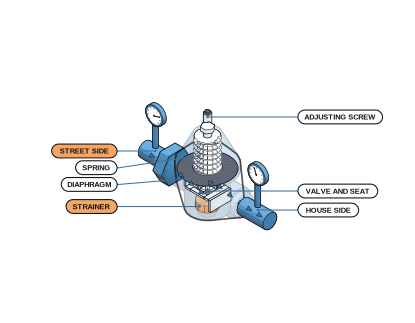
- Street side
- Water arrives from the city main. Street pressure varies by neighborhood and can change through the day.
- Strainer
- A screen ahead of the valve catches grit that could stop the valve closing properly.
- Valve and seat
- The valve moves toward its seat to let through only enough water to hold the house pressure.
- Diaphragm
- House pressure pushes up on the diaphragm. As that pressure rises, the diaphragm lifts the valve toward its seat.
- Spring
- Pushes down on the diaphragm to hold the valve open. The balance between the spring and the house pressure sets the outlet pressure.
- Adjusting screw
- Turning it changes the spring force, and so the setting. Many household regulators leave the factory set near 50 psi and adjust within a range.
- House side
- Regulated water goes on to the house. If the regulator fails, street pressure can reach every pipe and appliance.
- Street pressure in. Water arrives from the street at whatever pressure the city supplies, and that pressure can change through the day.
- House pressure out. The regulator lowers the pressure for the house. A plumber sets it with a gauge to suit the home; plumbing codes limit how high it may be.
- How it holds the setting. The spring pushes the diaphragm down to open the valve. House pressure pushes back up, and as it rises the valve closes toward its seat. The adjusting screw sets the balance.
- When it fails. Worn or dirty parts can let street pressure through to the house. High pressure strains water heaters, valves and appliances.
- Signs and testing. A failed regulator looks like a working one. A dripping relief valve can be a sign of high pressure, so a plumber tests it with a gauge.
Before you touch the regulator. Do not adjust or remove a regulator under pressure. Have a qualified plumber test the house pressure with a gauge, then set or replace the regulator.
Without a regulator absorbing city pressure spikes, your appliances get damaged. A water heater with 110 psi coming in has less than half its normal life, because every valve and entry point is built for 60 psi. It's like blowing up a balloon until it pops.
High pressure can also burst pipes in walls and slabs. A dripping T&P valve is often the first sign the regulator has failed.
What a pressure regulator does
Brandon at Quick Water Heater · 0:18–1:08
How a pressure regulator lowers the water pressure coming into your home.
Watch on YouTubeRather we did it?
Pressure regulator replacement