Why is my water heater leaking? Fix it in 4 steps
Quick answer
If you smell gas, leave the area and call your gas supplier or emergency services from outside. Otherwise, if safe to reach, turn off the heater's gas or electrical supply before shutting off its cold water inlet. Stay clear of hot water and standing water near electrical equipment. Call a qualified plumber before draining a hot or damaged tank.
Where is the water coming from?
Cutaway showing four places to inspect from a safe distance: top fittings, the relief valve and discharge pipe, the drain valve, and the tank body. Water can travel down the outside before it pools.
The heater stays see-through with its parts labeled. Turn or zoom the heater, then choose a part or a step. Use the arrow keys when the drawing is focused.
Still diagram and written explanation
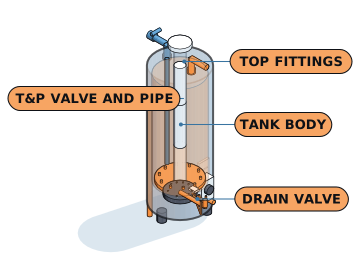
- Top fittings
- The hot outlet and cold inlet connections can leak. Water may run down the casing, so a puddle at the bottom alone does not prove the tank has failed.
- T&P valve and pipe
- The temperature and pressure relief valve discharges water if conditions become unsafe. Keep its pipe clear. Never cap, plug or bypass it; a plumber must investigate discharge.
- Drain valve
- The low valve provides a route out for cooled water during maintenance. A blocked or leaking drain needs inspection. Do not remove it from a hot or pressurized tank.
- Tank body
- The inner vessel holds the water. A confirmed leak through the tank itself usually means replacement, but a plumber should trace nearby fittings and valves first.
- Trace the source. Look from a safe, dry position. Water may run down from the top fittings or a valve before collecting below the tank.
- Repair or replace?. A connection or valve may be repairable. A confirmed leak in the tank body usually needs replacement. Have the cause assessed; do not loosen hot connections to investigate.
- Make it safe. If you smell gas, leave the area and call your gas supplier or emergency services from outside. Otherwise, if safe to reach, turn off the heater's gas or electrical supply before shutting off its cold water inlet. Stay clear of hot water and standing water near electrical equipment. Call a qualified plumber before draining a hot or damaged tank.
- Check warranty coverage. Keep the model and serial number for the plumber or manufacturer. They can check coverage; the diagram cannot establish whether a repair or replacement is covered.
Before you touch the heater. If you smell gas, leave the area and call your gas supplier or emergency services from outside. Otherwise, if safe to reach, turn off the heater's gas or electrical supply before shutting off its cold water inlet. Stay clear of hot water and standing water near electrical equipment. Call a qualified plumber before draining a hot or damaged tank.
1. Why it's leaking
Water heaters leak for two common reasons: lack of service, and high water pressure. Without service the tank corrodes and eventually leaks. A broken pressure regulator lets high pressure in, which also causes leaks.
Tank leak or connection leak?
Brandon at Quick Water Heater · 1:05–1:35
Brandon shows how to tell a leaking tank from a leaking connection.
Watch on YouTube2. Repair or replace?
- Top of the heater: usually a quick fix. Check the cold in and hot out supply lines, nipples and thread collars, and the vent connection.
- T&P valve: leaking from the valve to its pipe means a new valve, about $35 in parts, and probably a new pressure regulator too. Leaking where the valve threads into the tank means the tank can't be repaired.
- Bottom of the heater: water collecting under it means the heater has reached the end of its life and needs replacing.
3. Stop the leak
- 1
If you smell gas, leave the area and call the gas supplier or emergency services from outside. Do not operate switches or try to work on the heater.
- 2
If safe to reach, turn off the heater's gas or electrical supply before draining or shutting off its water. Do not enter standing water near electrical equipment.
- 3
Close the cold water inlet if you can reach it safely. Keep people clear of hot water and the discharge pipe.
- 4
Call a qualified plumber. A hot or damaged tank should cool and be assessed before it is drained. Do not undo supply lines or remove the relief valve to force it to drain.
4. Check your warranty
Manufacturers don't print warranty terms on the heater. They use codes in the serial number that tell plumbers when it was made. Your heater may still be covered, which can save you $600 to $1,000 or even get you a free heater.
Rather we did it?
Replacement from $2,695