Servicing a tankless water heater
Quick answer
A tankless needs a yearly flush. With a softener or scale prevention system, there's no need to flush it.
What a tankless service reaches
Cutaway of a wall-mounted gas tankless water heater, with service valves below it and a descaling pump connected for service. A generic layout; internal arrangements vary by model.
The heater stays see-through with its parts labeled. Turn or zoom the heater, then choose a part or a step. Use the arrow keys when the drawing is focused.
Still diagram and written explanation
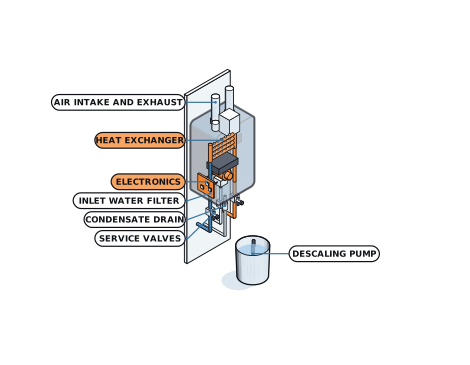
- Heat exchanger
- Water picks up heat as it passes through these coils. Hard water can leave mineral scale inside, which reduces performance and can lead to damage.
- Service valves
- Valves on the hot and cold lines close the unit off from the house plumbing. Their side ports take the hoses for flushing.
- Descaling pump
- During service, a small pump in a bucket circulates the cleaning solution through the heat exchanger and back, through hoses on the service ports.
- Inlet water filter
- A screen in the cold water inlet catches debris before it reaches the heat exchanger. It is cleaned during service.
- Air intake and exhaust
- The unit draws in air to burn the gas and vents the exhaust outside. A technician checks both, and the air filter where there is one.
- Condensate drain
- Condensing units drain off water that forms in the cooled exhaust. The drain has to stay clear.
- Electronics
- The control board, fan and wiring sit beside the water parts. A leak inside the unit can damage them.
- Minerals build up. As water passes through the heat exchanger, hard water can leave mineral scale behind. Scale reduces performance and can lead to leaks that damage the electronics.
- Service valves. With gas and power off, the service valves close the unit off from the house plumbing, and their side ports take the service hoses.
- The descaling loop. A pump circulates the cleaning solution specified for the model through the heat exchanger and back to the bucket. Then the unit is flushed through with clean water.
- Annual checks. A tankless needs a yearly flush. With a softener or scale prevention system, there's no need to flush it.
Before you touch the heater. Turn off gas and power as the manual directs before any service, and use the cleaning method and solution specified for your model. If a unit has never been serviced, ask a qualified technician to inspect it and follow the manufacturer's advice before descaling.
Why
Inside a tankless is a radiator, the heat exchanger. As water passes through, it leaves minerals behind that clog the heat coils and make the radiator leak. A leak damages the computer, the fan and the electronics. Service or isolation valves are what make flushing possible.
Annual maintenance and water treatment
A tankless needs a yearly flush. With a softener or scale prevention system, there's no need to flush it.
A technician checks the air intake, exhaust, condensate drain, filters and controls as well as the heat exchanger. Use the cleaning method and solution specified for your model. A softener also needs its own salt and service checks.
Replacing a heat exchanger after it fails is not a maintenance plan. If a unit has never been serviced, ask a qualified technician to inspect it and follow the manufacturer's advice before descaling.
What tankless maintenance involves
Brandon at Quick Water Heater · 0:24–1:14
What a professional tankless service involves.
Watch on YouTubeRather we did it?
Tankless flush and descale: $395, or $345 for plan members. Parts such as a new drain valve cost extra if needed.