Water heater anode rods
Quick answer
An anode rod corrodes in preference to the steel tank. Inspect and replace it according to the model's manual and water conditions. Maintenance does not guarantee a particular lifespan.
How the anode protects the tank
Cutaway of a storage water heater with the anode rod hanging inside the steel tank. The steps show the rod being used up as it protects the steel. Parts are enlarged for clarity; on some models the anode is built into the hot water outlet.
The heater stays see-through with its parts labeled. Turn or zoom the heater, then choose a part or a step. Use the arrow keys when the drawing is focused.
Still diagram and written explanation
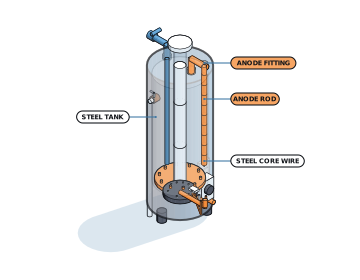
- Anode rod
- A rod of magnesium or aluminum that corrodes in place of the tank's steel. It is called a sacrificial anode because it is used up doing that job.
- Steel core wire
- The anode metal is formed around a steel wire. When the metal is used up, the bare wire is what's left.
- Anode fitting
- The rod hangs from a hex fitting on top of the heater. On some models it is combined with the hot water outlet.
- Steel tank
- The inner tank is steel, and steel corrodes in water. The anode protects it while there is anode metal left.
- Find the anode. The anode rod hangs from a fitting on top of the heater, down into the water inside the steel tank.
- How it protects. The anode corrodes in place of the steel, so the tank corrodes less. It is used up gradually as it works.
- It gets used up. How fast the rod is used up depends on the water and the model. Softened water can use it up faster.
- Once it is depleted. When only the bare steel core wire is left, the tank loses that protection and can start to corrode.
- Inspect it on schedule. Manufacturers set inspection intervals, and water conditions change them. A technician checks the rod and fits a compatible replacement when needed, alongside flushing and relief valve checks.
Before you touch the heater. Checking an anode means opening a fitting on a pressurized tank. Have a qualified technician follow the model's service instructions. Anode care helps, but it does not guarantee a particular tank life.
How it works
Your water heater is made of steel, and steel rusts. To stop the tank rusting and eventually leaking, anode rods are installed. The anode gives its own electrons to the steel to keep it rust and decay free.
The rod is consumed as it protects the steel tank. Once it is depleted, that protection is reduced. Follow the model's inspection schedule and use a compatible replacement when needed.
An anode rod after years in a tank
Brandon at Quick Water Heater · 3:09–4:06
A cut-open tank shows what years of corrosion do to an anode rod.
Watch on YouTubeWhy it matters most
Anode care is one part of maintenance. Flushing, relief valve checks and water pressure assessment also matter. Have a qualified technician follow the model's service instructions.
Rather we did it?
Anode replacement